


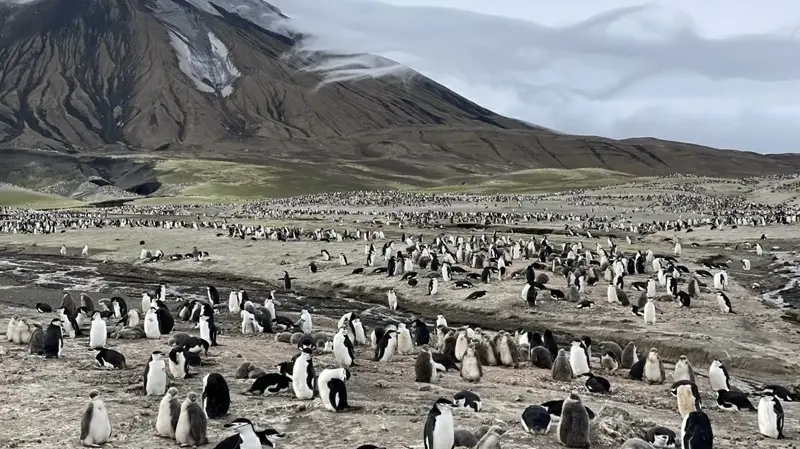
The above is the result of a new study published on October 7th in the journal Current Biology .
According to the British Antarctic Survey (BAS), drone and satellite imagery shows that between 2011 and 2025, the volcanic island of Zavodovski lost more than 680,000 penguins – equivalent to two-thirds of the total chinstrap penguin population.
The study's lead author, Norman Ratcliffe, noted that this is a very rapid decline. The research raises concerns that the number of chinstrap penguins across the South Sandwich Islands (including Zavodovski Island) – home to 38% of the species – is plummeting.
Survey results from 2011 showed that the chinstrap penguin population across the South Sandwich Islands remained stable.
However, their numbers on Zavodovski Island have declined from approximately 1.09 million breeding individuals in January 2011 to just 402,000 in 2025, a decrease of 63%.
The island is also home to another species, the Macaroni penguin. Its population is projected to increase from approximately 338,000 in 2011 to 433,000 in 2025, and now surpasses the number of chinstrap penguins.
Thus, Zavodovski Island is home to a total of over 835,000 chinstrap and macaroni penguins. With this figure, the Adélie penguin species at Cape Adare, on the other side of Antarctica, is currently the world's largest penguin population, with over 1 million individuals as of 2018.
Regarding the causes of this situation, researchers suggest that the eruption of Mount Curry on Zavodovski Island was not the main factor leading to the sudden decline in the number of chinstrap penguins, but rather the sharp decrease in crustaceans – their primary food source.
Warmer ocean temperatures have pushed these crustaceans southward to colder waters, where chinstrap penguins are less adapted.
According to Mr. Ratcliffe, the chinstrap penguin population on the island is declining at a rate of 7% per year, and climate change impacting the food web may be the main reason for this decline. Meanwhile, Macaroni penguins are increasing in number during the same period thanks to a more diverse diet.
Researchers concluded that this was the most dramatic shift ever recorded in the composition of a penguin community at a single location in Antarctica. This pattern of population change is a climate-induced regime shift, disadvantageous to Antarctic sea-dwelling chinstrap penguins but favorable to sub-Antarctic Macaroni penguins.
Given this alarming situation, researchers suggest that the International Union for Conservation of Nature (IUCN) should classify the chinstrap penguin as critically endangered, a more serious threat than its current "least concern" classification – meaning it is not yet facing the risk of extinction.