



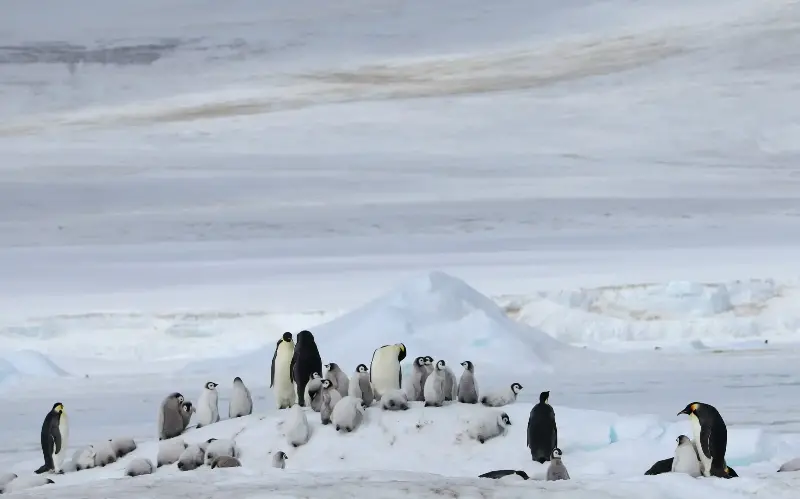
Huge numbers of Emperor penguins in Antarctica may have died because of melting sea ice, experts fear.
For the first time, scientists have used satellites to spot the places where penguins gather to moult and replace their feathers – on the coast of Marie Byrd Land in western Antarctica.
But satellite images show that the melting sea ice has forced the penguins into smaller, tightly packed groups and that between 2022 and 2024 the ice broke up before they had finished moulting.
Scientists fear that it may explain why the number of moulting colonies fell from more than 100 to just 25 after 2022.
Moulting is high risk for penguins because replacing their feathers takes an average of 34 days and they cannot enter the freezing water to hunt during that time, so cannot feed for several weeks.
If they are forced into the ocean before their feathers are replaced, they face exhaustion from increased energy use, hypothermia and being eaten by predators.
Dr Peter Fretwell, lead author and mapping expert at British Antarctic Survey, said: “Emperor penguins already faced a myriad of threats, and the loss of moulting sites is yet another pressure.
“While we don’t know for sure what happened to those penguins, we know they can find new suitable breeding sites after ice loss, so it’s possible they have established new moulting sites elsewhere.
“But also it’s possible that huge numbers of penguins perished after entering the Southern Ocean before they had replaced their waterproof feathers.
“If this has happened, the situation for emperors as a species is even worse than we thought.”
Emperor penguins are the largest penguin species, standing up to 4ft tall and weighing as much as 7st.
Each summer, emperors from the Ross Sea in West Antarctica migrate as much as 620 miles to Marie Byrd Land to find stable sea ice on which to moult. It is one of the few areas where sea ice remains attached to the coast even in the summer.
This population consists of seven breeding colonies accounting for up to 40 per cent of the global population.
It was not previously known exactly where the penguins go to moult, the annual process where the birds replace their feathers with new, waterproof plumage.
Researchers from the British Antarctic Survey (BAS) discovered the moulting colonies by chance, after spotting distinctive brown patches on satellite images.
The timing matched up with when emperors should have been moulting, prompting the team to take a closer look.
It is the first time scientists have observed moulting colonies using satellite images.
By comparing the location and timing of moulting with changing sea ice conditions, the team discovered that shrinking sea ice is forcing penguins into increasingly crowded groups, with potentially catastrophic consequences for their survival if the ice breaks up early.
After analysing seven years of satellite images, the team discovered more than a hundred groups of moulting penguins, located on fast ice along the coast.
However, in years with less sea ice, penguins were forced onto smaller patches in increasingly large and tightly packed groups.
Between 2022 and 2024, Antarctic ice coverage in the region fell to record lows, declining by 80 per cent.
During this period, the sea ice broke up before the penguins had finished moulting and it is likely that many of them were unable to survive, although the BAS said it was also possible they had moved to new, undiscovered moulting sites.
Experts from the BAS warned that Emperor penguins provide a window on the whole ecosystem.
The sea ice supports not just penguins but seabirds and seals, krill and whales, krill and whales – which are not studied annually – so emperors can be used as an indicator species, giving a hint about what might be happening across the ecosystem.