



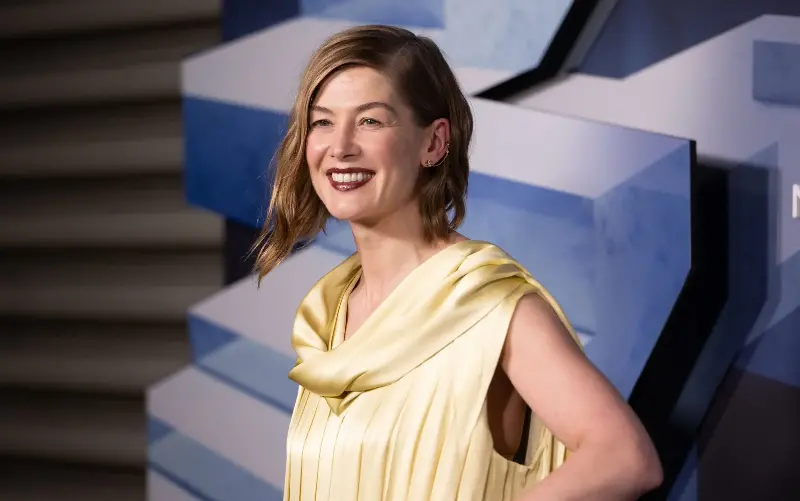
The Olivier Awards on Sunday night were graced by several established cultural icons, such as Ian McKellen and Helen Mirren. But after watching Rosamund Pike collect the Best Actress gong for her barnstorming performance in new play Inter Alia, the big question on my mind is: could Pike be about to join them as national treasures?
There is no doubt that Suzie Miller’s play – in which Pike stars as a trail-blazing Crown Court judge whose home life implodes when her teenage son is accused of rape – has created an incredible moment for Pike, and rightfully so.
Over the course of 100 minutes, she moves seamlessly between rock-star professional swagger and bewildered, poleaxed parent, juggling costume changes, legal jargon and even a burst of karaoke. Pike handles this whirlwind with total aplomb. It’s a technical feat of the highest order, and astonishing, given that she was last seen on stage 14 years ago, in Adrian Noble’s touring production of Hedda Gabler (The Telegraph described her performance as “deeply thrilling”).
No wonder Inter Alia shot into the West End following its National Theatre premiere and is heading to Broadway this autumn. American audiences, who know her for mainstream hits such as Amazon’s The Wheel of Time, are going to get to see what she is really made of.
In fact, it feels as if Pike is finally getting her due after a career that has had its fair share of twists and turns. It began in conventional British fashion, with the Oxford-educated actress gracing TV period dramas such as the Nancy Mitford adaptation Love in a Cold Climate, but then she entered the big league when she became a Bond girl in 2002’s Die Another Day. Pike was just 21 when she was cast, and has since said she wished she’d taken a different approach – perhaps spoken to a real spy – to make her characterisation more real, although this particular Bond film wasn’t exactly blessed with verisimilitude (it’s the one with the ice palace, invisible car and Madonna).
She returned to her costume-drama roots with the well-received Pride & Prejudice film, playing dutiful eldest sister Jane Bennet, but her subsequent movies were a mixed bag, including witless Hollywood fare such as the Tom Cruise-starring Jack Reacher and dire fantasy sequel Wrath of the Titans. It felt as if the industry wasn’t quite sure what to do with Pike, whose English-rose looks and cut-glass vowels conceal a far spikier, more daring and, crucially, funnier performer than one might expect.
Thank goodness for director David Fincher, who gave her a gift of a role in the twisted 2014 thriller Gone Girl. Starring opposite Ben Affleck, Pike was deliciously disturbing as the psychopathic Amy Dunne, who plots an elaborate revenge against her feckless husband. Her performance, which slyly riffed on her public image as a picture-perfect blonde, was a revelation. She was nominated for a Best Actress Oscar, and, in my view, should have won: instead Julianne Moore nicked it for dreary Alzheimer’s drama Still Alice.
That might have been a game-changing moment for Pike, but she stepped away to focus on motherhood: she had her second son (with businessman husband Robie Uniacke) soon after Gone Girl and, at the Oliviers, thanked Uniacke for “[staying] at home and looking after our children”. Pertinently, Inter Alia also concerns the impossibly tough choices made by working mothers.
Her hiatus was, perhaps, beneficial. Pike has since made interesting choices which defy any attempt to pigeonhole her, whether portraying the ferocious foreign correspondent Marie Colvin in A Private War or winning a Golden Globe in 2021 for her gleefully amoral grifter in I Care a Lot.
In some ways, her greatest triumph was Emerald Fennell’s 2023 class-warfare comedy Saltburn, in which her fabulously piquant Lady Elspeth Catton stole every scene thanks to Pike’s peerless delivery of lines such as “I have a complete and utter horror of ugliness” and “I was a lesbian for a while, you know, but it was all a bit too wet for me in the end. Men are so lovely and dry.” It gave us definitive proof that Pike is a brilliant entertainer, offering true value for money (see also an early supporting role, opposite Carey Mulligan in An Education), who can elevate an entire film even in a supporting role through her immaculate comic timing.
Does she have emotional range as well, worthy of the great Dames Judi Dench, Harriet Walter and Eileen Atkins? I’m less convinced of that, although perhaps it’s a question of finding a role to suit her. Her theatre CV is relatively small, and she is yet to tackle Shakespeare.
Of course, Pike is not entirely immune to dodgy choices: her villainous South African diamond heiress (complete with a truly wild accent) in this year’s film sequel Now You See Me: Now You Don’t is a case in point. But at least she’s having fun, and you wonder whether having fun is a deliberate part of the plan; that Pike is looking upon the whole industry with an eyebrow archly raised.
After Inter Alia goes to Broadway, you could see that a Hollywood career may come back sharply into focus. Whether that is what this supremely interesting actress wants is another matter.