



After early space missions crashed back to Earth, scientists were desperate to learn what they had uncovered.
What they couldn’t have counted on was the foul stench that erupted through the capsule door as it opened for the first time in several days.
Apollo missions’ astronauts faced floating faeces, bags of urine strapped to their bodies and no changes of clothes.
Today, however, it’s a much more state-of-the-art affair.
A hi-tech toilet system, air filters and a specialised hygiene pack all keep the air smelling fresh.
The first men on the Moon didn’t have toilets; instead wearing adhesive-sealed plastic bags attached to their bodies to collect urine.
They did, however, take razors up with them, with Old Spice shaving foam the only real counter to the rising odour.
On the Apollo 11 mission in 1969, astronauts wore the same clothes for the whole eight-day journey.
Jennifer Levasseur, a curator in the Smithsonian Museum’s space history department, said: “The astronauts had been in their suits so long without changing their clothes that the scent lingered the entire time.
“It was a slap in the face to those who greeted them upon their return because the scent was so strong.”
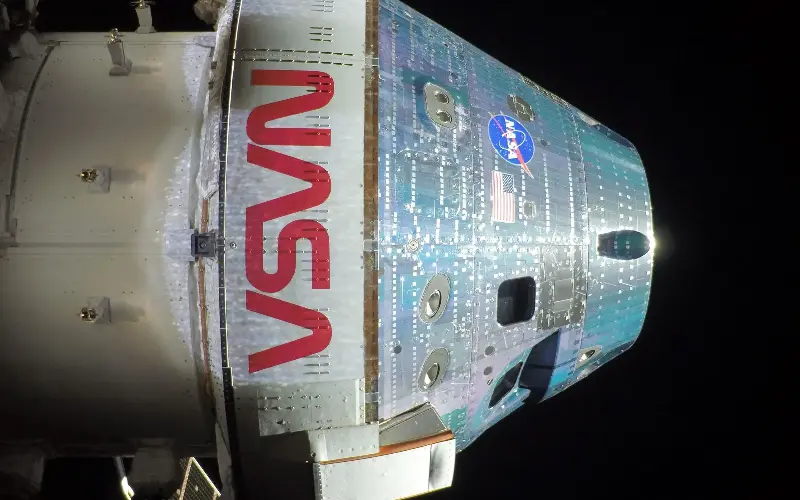
Today’s astronauts aboard Nasa’s Artemis II mission to the Moon, which is more than halfway through its 357,000-mile journey, have a much easier time.
The Orion capsule has a carbon dioxide and humidity removal system, which helps to keep the air clean by removing gases such as ammonia and acetone that humans emit through breathing.
The shuttle is equipped with a hygiene bay around the size of a plane toilet – with doors for privacy, a toilet and space for the crew to bring in their personal hygiene kits.
These packs contain a hairbrush, toothbrush and toothpaste, liquid soap and rinseless shampoo – though astronauts have admitted the shampoo leaves an unpleasant residue.
To wash their hair, astronauts use foil-and-plastic bags with straw-like nozzles, which they place directly against their scalp before combing the water through their hair with their fingers.
But Karen Nyberg, who spent 166 days in orbit on the International Space Station (ISS), told The New York Times in 2022 that her hair “never really felt clean”. After a few months, her hair would hold the shape of a ponytail even without a hairband.
The Artemis II astronauts wear high-tech sweat-wicking clothes underneath custom-made orange spacesuits, which will help rescuers find them after they travel down at the end of the mission.
And they change out of these clothes to go to sleep, putting on pyjamas.
Though Commander Reid Wiseman was heard asking about the location of their “comfort garments” as he struggled to find them on Wednesday.
Crew members brush their teeth with normal toothpaste, but then typically swallow to avoid floating spit balls.
Orion’s toilet, known as the Universal Waste Management System, is a far cry from the non-existent toilet of the Apollo missions.
The earlier space flights were riddled with problems, including floating faeces in 1969.
According to flight logs from the Apollo 10 mission to the Moon, Commander Thomas Stafford said: “Give me a napkin quick. There’s a turd floating through the air.”
Now, the Artemis crew has been afforded the luxury of strapping themselves to a specialised seat, which sucks stools away into a smell-free container.
For urine, each astronaut has their own personal funnel with a fan that draws the liquid into a tank, removing any nasty smells.
But the Orion crew still had an uncomfortable few hours without a toilet after takeoff last week, with Christina Koch forced to act as an emergency space plumber before it could be used safely.
More recently, Victor Glover, Artemis II’s pilot, was broadcast with his shirt off as he wiped himself down with a towel after 30 minutes of exercise on Friday. The shuttle has an exercise machine called the “Flywheel”, which can be used as a rowing machine and also for strength training.
When astronauts sweat, it forms pools on the body, rather than dripping off, so it has to be wiped away.
“NASA astronaut Victor Glover, having completed his exercise, is cleaning up in space,” a spokesman said. “Obviously, we do not have showers aboard the Orion spacecraft.”
Although a shower was developed for space travel in 1973, for use on the US’s first space station, Skylab, the process was too cumbersome for the Artemis team’s 10-day mission.
Astronauts would spend hours showering with their feet strapped to the bottom of the tube-shaped pod to keep them steady, and they had only three litres of water to use.
Excess water also had to be painstakingly mopped up after washing, to avoid damaging crucial technical equipment.
It was such a difficult process that astronauts on the ISS reverted to sponge baths, with shampoo that doesn’t need to be rinsed out and an extraction system for excess water.
Astronauts compared the “showers” to washing while camping, but no matter how much soap and deodorant they use, it isn’t a match for the real thing.
In 2016, Tim Peake, a British astronaut, wrote: “I already miss my shower at home, but this gets the job done.”
Instead of laundry, astronauts send dirty socks and wet towels away in a cargo spacecraft to burn in Earth’s atmosphere.
But not until almost all the water has been wrung out of them, so that it can be recycled.
The water recovery system on the ISS can turn urine and sweat into drinking water, and recycles as much as 98 per cent of wastewater.
Thankfully for Artemis’s crew, their urine is being jettisoned into space instead. So they won’t have to drink it.
On Thursday, Ms Koch filmed the wastewater being vented from Orion, with sparkling beads of water seen shooting into space.
But with the Orion crew not due back until Friday, it remains to be seen whether rescuers picking the astronauts out of the Pacific Ocean will best remember their bright orange space suits – or their stench.