



It is strange walking from Sloane Square towards the Royal Hospital when Chelsea Flower Show is not on. The red-brick buildings are still there, the London planes neatly pollarded. But the tide of Panama hats, floral dresses and overexcited gardening pilgrims who flood the area in May each year are nowhere to be seen.
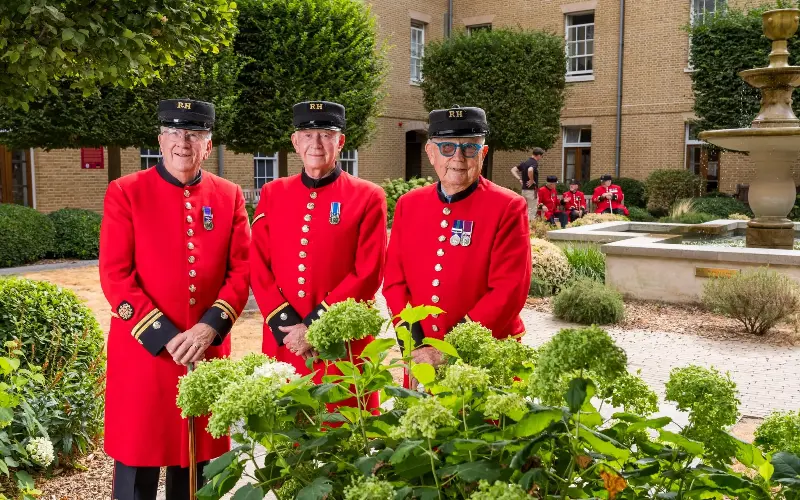
The gates of the Royal Hospital Chelsea, which hosts the event, are closed to the public when out of show season, but behind them life continues. This is a 17th-century institution designed by Sir Christopher Wren and home today to nearly 300 British Army veterans, the Chelsea Pensioners, instantly recognisable for their ceremonial scarlet coats.
On my visit, the residents’ choir is rehearsing to a small audience. It is pleasantly domestic – in stark contrast to the circus that is the “world’s greatest flower show”, as the RHS coins it. Which is fitting, as I have come to see the show garden that never was.
Designed by Matt Keightley and the team at Rosebank Landscaping, the small courtyard garden was originally intended for the 2020 Chelsea Flower Show. When the pandemic forced the show’s cancellation, it was never exhibited and never judged. Instead, it went straight to its permanent home at the Margaret Thatcher Infirmary (MTI), built as a therapeutic garden for Chelsea Pensioners, including residents living with dementia.
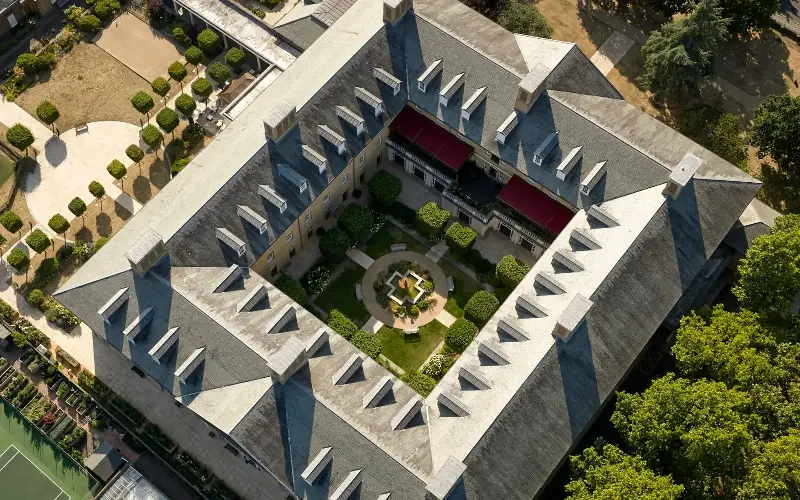
“It’s a shame, of course, that it wasn’t seen by thousands that year. But it’s our hidden show garden,” says Ric Glenn, head of gardens at the Royal Hospital. “It was always supposed to be a calm place for our community here and the residents of the MTI. For me, this is one of the calmest corners of the 66 acres that I look after. It’s very, very tranquil.”
Glenn has been managing the gardens and grounds here for seven years and has watched the courtyard mature from a newly planted scheme into a place that feels entirely at home within the hospital. It has become a place of sanctuary for those who need it, both inside and out.
Not every resident is able to come down into the courtyard, but the garden was designed to be experienced from the surrounding rooms, too. From the windows of the infirmary, residents can look down on to a space that shifts with the seasons: the leaves of the large hornbeams turning golden in the autumn, gardeners tinkering in the beds below.
“Many enjoy this calm space simply from their window,” Glenn says. “I know those who are interested in birdwatching have noticed nesting birds moving in this year. It means the residents are connecting with nature even if they can’t get outside. They can see the leaves, see the birds and hear the fountain trickling, reverberating across the courtyard.”
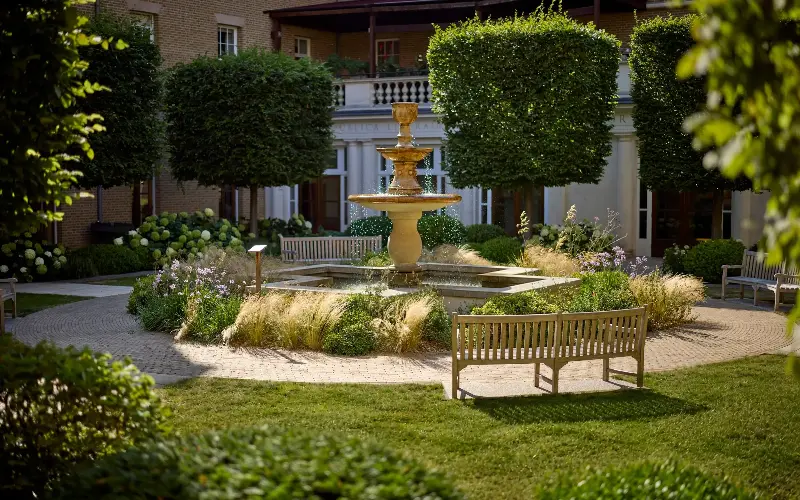
The garden measures 28m by 28m and the design is pleasingly simple. The fountain at its centre was already there, providing a subtle point of orientation and contributing to a space that feels instinctively easy to navigate, with surrounding swirling beds and curved paths surrounded by large, cubed hornbeams.
“Logistically it was difficult with these trees,” Glenn says. “Getting them through our little arch was a challenge. In carpentry they say measure twice and cut once. Well, I think we measured about 10 times, and we had to cut the trees once. There were times where we did consider getting a helicopter or a crane, and then we discounted that and just had to shave the edges.”
Designer Matt Keightley is relieved they found a solution. “The monolithic architecture was always going to be able to take the presence of the boxhead hornbeams. The impact and structure they provide is a real success.”
Keightley, a well-known garden designer and two-times winner of the coveted People’s Choice Award at Chelsea, continues: “During construction it was amazing to see the pensioners watching the space come together from various levels and different windows that face in towards the courtyard.
“Watching the joy it brought, the claps and cheers when each tree went vertical, was really special.”

To one side of the courtyard there is a large balcony which is part of the dementia ward. Here, residents can sit and enjoy the garden from a special vantage point. The planting, design and sightlines through the garden were considered for all residents, but particularly those who have dementia.
“Having witnessed family members go through later stages of life with dementia, it only emphasised the importance to get the design right,” Keightley says. “Somewhere to feel safe, a space that can provide seclusion. It is designed so people can see through it. Dementia patients feel comfort seeing into space and being able to see out too.”
For Chelsea Pensioner Archie, who created a balcony garden on the dementia ward, one of the courtyard’s simplest elements has proved particularly effective. “The noise of the fountain is a little bit like a waterfall or running stream, and we can hear it from our balcony garden,” he says. “It really adds something and is very soothing.”
Fragrance is also central to the planting. “Rosemary is placed at the heart of the garden and along the fringes as it’s a hugely nostalgic fragrance for the residents,” Keightley continues.
But it’s not the only scent hanging in the air. Garlic is the eau de Chelsea here, emanating from Tulbaghia violacea, otherwise known as society garlic. Native to southern Africa, it looks rather like a miniature pink agapanthus, its mauve flowers nodding on slender stems in the breeze. This summer, it positively revelled in the heat, flowering without any supplemental watering.
“Scent can trigger memories for people, and I think that probably becomes more important when you’re starting not to remember things,” Glenn says. “To have triggers that will jolt a little memory for you, even just for a moment. I know Matt was thinking about that when he was designing the space.”
There is a limited colour palette of green, white and violet. White comes from valerian, Centranthus ruber ‘Albus’, that has flowered since spring with a chop back in early summer. Anemone ‘Honorine Jobert’ is also putting on a solid show at the time of my visit, single-flowered white saucers with honey-yellow centres that attract pollinators. They perform remarkably well in dry shade under the canopy of larger shrubs and cubed Carpinus betulus trees, much like Hydrangea arborescens ‘Annabelle’ that is doing well here with protection from above. The violet society garlic flowers and creeping geraniums add pops of pink and mauve.
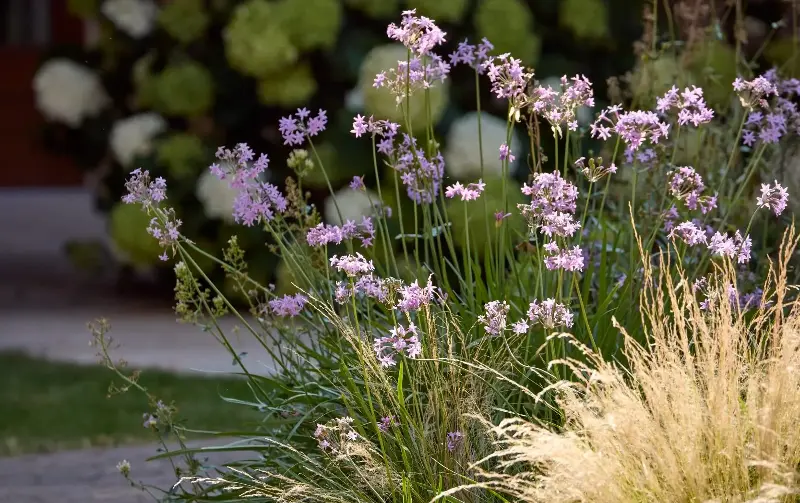
“Having a colour palette that’s not too wide feels right for a space like this,” Glenn says. “And green is not just one colour. Green is thousands of colours, and in my experience it’s the most calming.”
Grasses are used as matrix plants throughout, repeated for height and movement, including Stipa gigantea, Stipa tenuissima and the Pennisetum alopecuroides ‘Hameln’ with its pinky-white bottlebrush flowers that sway in the breeze.
“It feels incredibly calming,” Glenn says. “We are in the middle of one of the biggest metropoles in Europe, but I don’t feel that here. Even when the flower show is on and we have 150,000 visitors, it still feels calm.
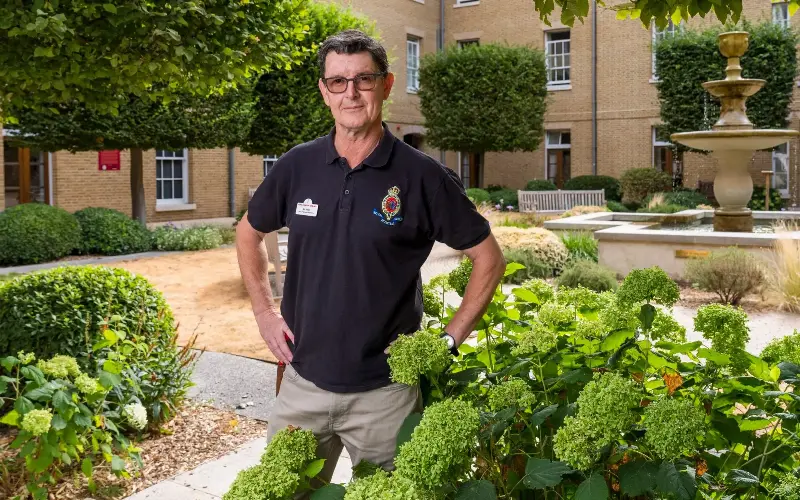
“If a resident can come, just for a few minutes, smell something, see something, be transported, then we have achieved what we wanted.”
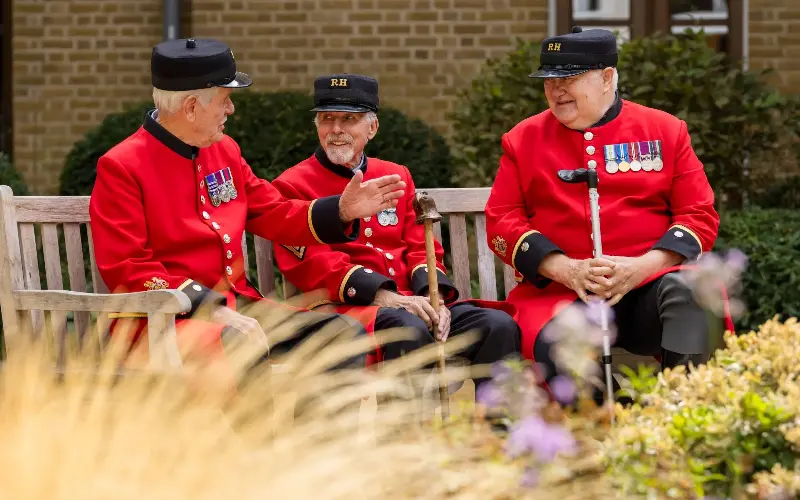
Right on cue, a Chelsea Pensioner takes a seat on one of the timber benches positioned to encourage conversation and contemplation. He gazes skywards, the September sun catching his face, while the wind kicks up an aroma of earthy garlic and rosemary.
This hidden courtyard is the show garden that never was. But it has become exactly what it needed to be.