



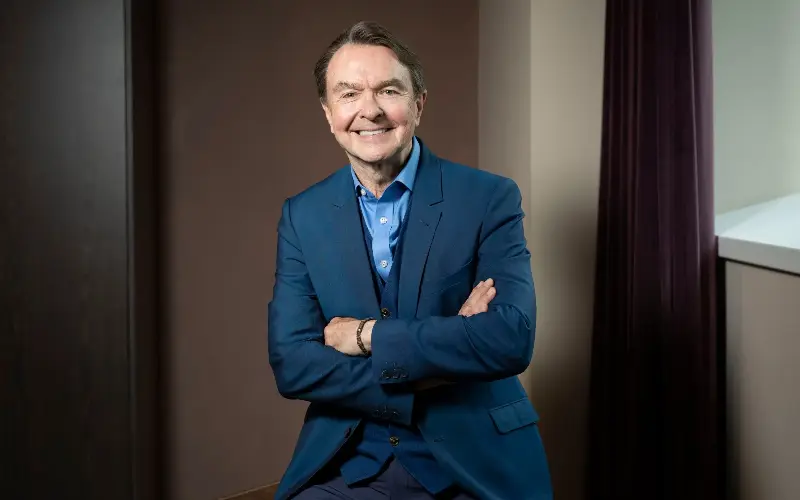
It’s hard to escape the word “longevity”. It is so ubiquitous it can sometimes feel meaningless, and yet something about the work of globally acclaimed longevity guru Michael Clinton, 73, and his new book Longevity Nation: The People, Ideas and Trends Changing the Second Half of Our Lives is cutting through.
According to the editor of Esquire, “Clinton stands at the vanguard of a new social movement as a leader of and evangelist for those roaring into the second half of life.” The founding director of Stanford University’s Center on Longevity, Professor Laura Carstensen, describes his book as “essential reading”. Certainly, his journalistic background and 20 years running Hearst Magazines in New York gives him unprecedented access and insight into the major trend shaping all of our lives.
“Longevity,” he explains, “is really just a trendy way of talking about ageing. It is a current hot topic because in the Western world at least, life spans have nearly doubled in the last 100 years. Children born today in the West have a more than 50 per cent chance of living to 100 [according to projections by Stanford Center on Longevity].” The goalposts are shifting in real time, which makes the L-word a hot topic for us all.
We meet on a baking hot afternoon. In his mid-70s, he’s a great poster boy for reinvention (he ran a marathon on Everest to celebrate his 70th birthday) and has the energy of a man a third of his age. Rather than retiring at 65 from his role as president and publishing director of Hearst in New York, he set up an organisation called Roar Forward to educate global companies on how to reject age stereotypes and embrace the increasing number of employees over 50.
He may not be a doctor himself, but he has spent the last two years in the company of all the biggest experts in science, government and business. So, what has he gleaned from spending time with the global authorities on how to live longer, healthier lives?
The one thing all longevity experts do
For Michael, time is of the essence: he’s only in London for 24 hours. Then he’s due in Lisbon for a longevity conference, then Cannes Lions Ad Festival, then Athens, before whizzing back to his native New York. There’s no time to waste, so I jump in. What, I wonder, is his takeaway from all his research?
He grins, his face alive with fun and mischief. “It’s simple, Eleanor, movement! I’ve spoken to all the world’s top experts and moving everyday really is the magic bullet. There are all sorts of supplements out there but any doctor will tell you that movement is the best natural medicine. Being fit prevents falls and becoming frail as we age.”
What does that mean for us day to day? He explains that his idea of relaxation is running around Central Park. “It doesn’t have to be running but the base prescription when it comes to movement according to all the doctors and longevity experts I have talked to is 150 minutes of moderate aerobic activity a week; or 75 minutes of vigorous exercise. That needs to include aerobic training, weight resistance with some balancing exercises for physical well-being. For people over 65, add in Tai Chi, yoga and Pilates. Learning complex movements is also good for brain health.”
What’s his advice for all couch potatoes out there? “Baby steps,” he says. “Starting a new habit may be hard but take a first baby step and hang in there. I interviewed Joan Macdonald for my book, who only started going to the gym in her early 70s to build strength. Now in her 80s, she’s a trainer with over two million followers on social media.”
The key, he explains, is to get sweaty and work our core and key muscles every day. “‘Motion is lotion’, as Weill Cornell doctor Mark Lachs says. During the week you should include aerobics, flexibility, mobility and weight training for strength. Just get out there and do something. Take the stairs, do squats while you’re on a call, stand on one foot for as long as you can while you’re cooking, stretch out on the floor and do crunches while you’re watching your favourite television series. Even doing exercise in 10-minute increments a day is meaningful.”
Don’t let your genes dictate your next chapter
I’m surprised to hear that the impact of genetics on how long we live is not as big as many of us think. “There are multiple studies and supporting research that have established that only 25 per cent of longevity is determined by genetics,” Michael explains. The remaining is due to lifestyle, environment and other factors. “So if your parents lived well into their 90s you might have a head start, but it’s unlikely to be enough to carry you into your own 90s and beyond if you don’t pay attention to the 75 per cent not determined by genetics.”
What about his own family background? “I was raised as the oldest of six children in a working-class family in Pittsburgh. We ate only processed foods, no one exercised and my parents both smoked. I became interested in health in my 20s and many of my good habits started then. I started getting interested in longevity when I was wrapping up my first career as president and publishing director of Hearst. People kept saying ‘Oh, are you going to retire?’ My response was: ‘I have a lot more that I plan to do.’ If you are 65 and healthy you may live another 30 or more years. It’s a whole new chapter that our parents never dreamed of.”
We must expand our lives as we age
It is easy to fall into the trap of feeling like a more fragile being as the years tick by. “Self-imposed ageism leads to the mantra of ‘I can’t do that because of my age’ or ‘I shouldn’t do that because of my age’, which leads to unnecessary restriction instead of expansion in our lives,” observes Clinton. You can see it in the older generation. They fall once and then are scared to leave the house. Or things ache so they stop exercising or feel they are too old to take up sport.
So how do we combat that? As a media beast, he sees the power of positive older role models. “How old do you think Oprah is?” he asks. He speedily answers his own question. “She’s 72. That’s what being in your 70s looks like now.”
TV and films, he says, also have a responsibility to help shift attitudes. We talk about the recent crop of movies and TV programmes featuring older protagonists such as Harrison Ford at 83 in Shrinking, or Nicole Kidman at 56 in Baby Girl. I say that I see many of these closer to home too: my mother is still skiing at 82, while another friend of mine went clubbing with her grandchildren for the first time at 83.
He nods vigorously. “We need to let people know that you can become an entrepreneur at 75, start a creative endeavour at 80 or get remarried at 90. Stop saying ‘age appropriate’. Age really is just a state of mind.” Indeed, research from the US suggests older founders are twice as likely to be successful as younger ones.
Splurges need to be occasional
Clinton looks enviably slim. He laughs. “Yes, unfortunately another key longevity protocol from all the experts includes rethinking our eating habits. I haven’t eaten meat in 50 years and follow a diet of fish and lots of salads and legumes with a focus on eating at least 60 grams of protein each day. I drink a 32 gram protein shake each morning.”
Wow, that doesn’t sound like much fun, I say. I thought saying “yes” to joy was also a key part of longevity? “It is. Enjoying our lives, being in community with people we love and having fun is very important. I’m a moderate wine drinker and happy to have a margarita with some Tex-Mex food . But the key to longevity is making these kinds of splurges occasional.”
Clinton says there is another aspect to diet which not enough of us think about, and which can be more of a challenge. “It’s not just about what we eat, but how much. As we get older we need to eat less. Longevity researchers believe that dietary restraint helps with our healthy lifespan. My strategy as a result of all the research is to eat 80 per cent of what I instinctively want to, and not to go back for seconds.”
A final message
Our time is coming to a close. Numerous longevity luminaries, including Linda Gratton, the London Business School professor who arguably kicked the longevity era off with her book The 100-Year Life: Living and Working in an Age of Longevity, are arriving for Clinton’s book launch party.
I ask him quickly for his advice for those who want to get on the healthy ageing page.
“Everyone should have a wearable of some type to track sleep patterns, daily steps, calories and VO2 max,” he says. VO2 max is the maximum volume of oxygen your body can use during exercise and is considered one of the strongest, most reliable predictors of human lifespan and healthspan. He practices what he preaches: “I love the health metrics I get from wearables on a daily basis. The data is an indication of our overall health allowing us to be more preventative and get ahead of potential issues.”
As he turns to leave he says: “Spreading the word on longevity, digging into the science has become my life’s passion. But, you know, that’s something I really didn’t discover until I was in my 60s...”
I find that inspiring. What could you do with the rest of your life?