



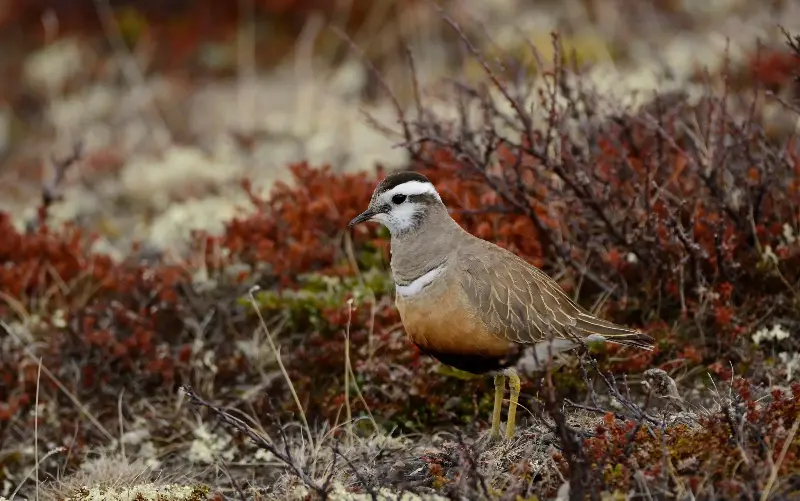
The dotterel could become the first bird to become extinct in Britain because of climate change, the RSPB has warned.
The small wading birds are part of the plover family and migrate to mountainous regions in the UK each summer to breed, but their numbers have fallen by nearly 90 per cent since 1988.
Notable for their rusty-orange chests and white eye streaks, the birds need low-growing, alpine vegetation on rocky plateaus to lay their eggs, but their habitats are dwindling, meaning they are struggling to reproduce.
A survey carried out last year by the RSPB found that only 22 of the 217 sites surveyed contained breeding male dotterel, and there were none detected at all in England, Wales or southern Scotland.
Unlike most birds, male dotterels stay with the nest and incubate the eggs while females move on, so sightings of males are used to estimate breeding population size.
Leah Kelly, an RSPB conservation scientist, said: “Dotterels are in steep decline and we are seeing them disappearing before our very eyes.
“The fact they need mountaintops to breed has made them particularly susceptible to habitat loss as climate change alters their montane environment.”
The dotterel’s name is thought to come from the Old English for dolt or dullard because of its unsuspecting nature and lack of fear of humans, which led to it being widely hunted. Its Scottish Gaelic name is amadan-mòintich, which means “fool of the moors”.
Playwrights from the 16th and 17th centuries, such as Ben Jonson, frequently used the bird to represent human gullibility.
Large numbers of dotterels used to fly from northern Africa to Britain each spring to breed, but their trusting nature made them an easy target and their numbers were greatly diminished by the 20th century.
Most of the remaining population is now restricted to the eastern and northern Highlands of Scotland. But hotter and drier conditions are forcing specialist species such as the dotterel to move to higher and higher altitudes until they have nowhere left to go.
While the global population of dotterels is classified as Least Concern by the IUCN, their future in Britain appears increasingly dire and the species is included on the UK’s Birds of Conservation Concern Red List.
Dr Nicola Largey, NatureScot ornithologist, said: “The striking dotterel has long been a special sight for those who spend time in Scotland’s uplands and mountains, but sadly the evidence shows the species is now in precipitous decline.
“The potential loss of this distinctive bird from our hills demonstrates the urgent need to tackle the twin crises of climate change and biodiversity loss that are threatening our wildlife and the habitats they depend on.
“At a local level, managing pressures on dotterel habitat such as overgrazing can give us the best chance to retain them.”
The new survey showed declines even in previously stable areas, such as the Cairngorms.
The results also showed a decline of 71 per cent in special protection areas, suggesting that climate change is one of the key reasons for the falls in numbers.
Cranefly larvae, the dotterel’s preferred food, also appear to have undergone declines in UK mountain sites based on the number of adult craneflies observed.
The RSPB has called for hikers and dog walkers to keep clear of areas where dotterels breed to avoid disturbing the remaining birds.