



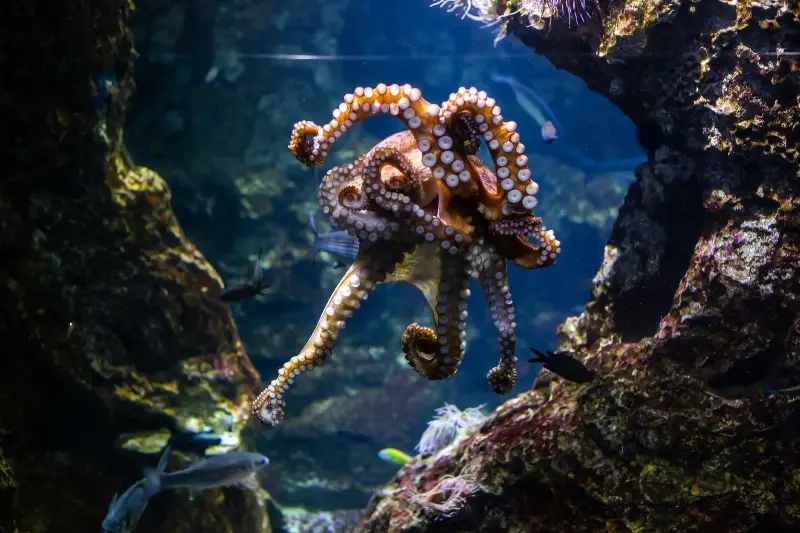
Octopuses are among the worst animals to leave behind as fossils. Their bodies are mostly soft tissue. They have no backbone, no shell like an ammonite, and no heavy skeleton that can survive for tens of millions of years.
That is why a few fossil jaws can change the picture so sharply. In a 2026 Science paper, researchers reported that hard beak parts preserved in Late Cretaceous rocks point to giant finned octopuses that lived between about 100 million and 72 million years ago. The largest of them, Nanaimoteuthis haggarti, may have reached roughly 7 to 19 metres in length.
At the upper end, that would make it longer than many buses and far larger than any octopus alive today. It would also place a soft-bodied invertebrate near the top of ancient marine food webs usually imagined as the realm of sharks, plesiosaurs and mosasaurs.
Why jaws matter so much
The fossils at the centre of the study are not complete octopus bodies. They are jaws, or beaks, made of chitin, the tough material also found in arthropod exoskeletons. For octopuses and their relatives, these beaks are often the best chance of survival in the fossil record.
The research team, led by Shin Ikegami of Hokkaido University with colleagues in Japan and Germany, examined 27 fossil jaws from Late Cretaceous deposits in Japan and Vancouver Island. Fifteen had been known before but were reinterpreted, while another 12 were detected inside rock using high-resolution digital methods rather than ordinary splitting and surface inspection.
That detail matters because it explains why such animals could stay hidden. A giant octopus might have left no obvious outline, no tentacle marks, and no complete body impression. Its most durable trace could be a dark, curved jaw sealed in a concretion, waiting for tomography and digital reconstruction to expose it.
The study assigned the fossils to finned octopuses, or cirrates, in the genus Nanaimoteuthis. These were not modern shallow-water octopuses scaled up like props. Finned octopuses belong to a different branch of octopus life, with paired fins and a more gelatinous deep-sea body plan among living relatives.
A predator inferred from damage
The most striking part of the evidence is not only jaw size. It is jaw wear. The fossil beaks show blunting, chipping and asymmetric abrasion, patterns the authors interpret as the result of repeated processing of hard prey.
In modern octopuses, the beak is not just for swallowing. An octopus can grip prey with its arms, pull it toward the mouth, and cut or crush hard parts with the beak. If the Cretaceous jaws were being worn down in a similar way, these animals were not passive drifters or soft prey items. They were active hunters capable of dealing with shells, bones or other resistant tissues.
The Science paper argues that the largest Nanaimoteuthis species may have competed ecologically with the big vertebrate predators of its time. That does not mean researchers found a mosasaur inside an octopus stomach. It means the size estimates, jaw damage and feeding mechanics are consistent with an animal that could occupy a high predatory tier.
The finding also pushes against a common bias in ancient ocean reconstructions. Vertebrates fossilize well. Shell-bearing animals fossilize well. Soft-bodied predators do not. If only the hard-bodied animals are visible, the food web can look more vertebrate-dominated than it really was.
How big is the biggest claim?
The body-length estimate is dramatic, but it is also the part that needs the most care. The team estimated size by comparing fossil jaw measurements with relationships between beak size, mantle length and total length in living octopuses. Using those comparisons, Nanaimoteuthis jeletzkyi was estimated at roughly 3 to 8 metres, while N. haggarti was estimated at roughly 7 to 19 metres.
Those ranges are broad because the animal is known from jaws, not from a complete body. A fossil jaw can reveal a great deal about feeding, taxonomy and relative size, but it cannot lock down exact arm length with the certainty of a preserved skeleton. The upper estimate should be read as plausible under the model, not as a measured body stretched across a quarry floor.
That caveat does not make the fossil unimportant. Even the conservative end of the estimate points to a very large octopus-like predator. At 7 metres, N. haggarti would still be larger than any confirmed living octopus and large enough to alter how scientists think about who was hunting whom in Cretaceous seas.
Several outside researchers have made the same distinction. They do not dismiss the animal as small or ordinary, but they caution that focusing only on the maximum length can overstate what the fossils prove. The jaws are real. The predatory wear is real. The exact full-body silhouette remains reconstructed.
Not just bigger, but possibly more complex
The asymmetric wear on some jaws adds another layer. In living animals, repeated use of one side of the body more than the other can indicate lateralized behaviour, a form of left-right preference. Modern octopuses are known for complex behaviour, problem solving and flexible arm use.
The fossil record cannot measure intelligence directly. It cannot show how Nanaimoteuthis explored an object, opened prey or chose one arm over another. But the pattern of wear suggests these animals may not have fed randomly. They may have used their jaws and arms in consistent, task-specific ways.
That is a careful inference, not a personality test for an extinct octopus. Still, it supports the broader picture of a large, active predator rather than a simple soft-bodied animal occupying the background of a reptile-dominated ocean.
A hidden part of Cretaceous seas
The Late Cretaceous ocean was not short of formidable animals. Mosasaurs, plesiosaurs, large fish, sharks, ammonites and marine turtles all belonged to complex food webs. What the Nanaimoteuthis jaws add is a harder-to-see player: a giant invertebrate predator whose soft body usually had little chance of fossilizing.
That makes the discovery less like adding a monster to a prehistoric roster and more like correcting a blind spot. The Cretaceous sea may not have been ruled only by animals with bones and teeth. Some of its most capable predators may have had arms, chitinous jaws and bodies that almost never survived burial.
The fossils do not prove every dramatic scenario. They do not show an octopus pulling down a marine reptile, and they do not fix the exact maximum size beyond debate. But they do show that some of the earliest known finned octopuses were far larger and more ecologically important than scientists had recognised.
For an animal made mostly of soft tissue, that is an unusually strong afterimage. A few jaws hidden in Cretaceous rock were enough to reveal that, 100 million years ago, the oceans may have held giant octopuses that were not merely prey, but predators worth fearing.
Sources
- Ikegami et al., “Earliest octopuses were giant top predators in Cretaceous oceans,” Science, 2026
- The Guardian report on the Science study and fossil jaw evidence
- Live Science report with outside expert caution on size estimates
The post Fossil jaws hidden inside Cretaceous rocks have revealed that 100 million years ago, some octopuses grew into giant predators — possibly longer than a bus and more fearsome than any octopus alive today. appeared first on Space Daily.