



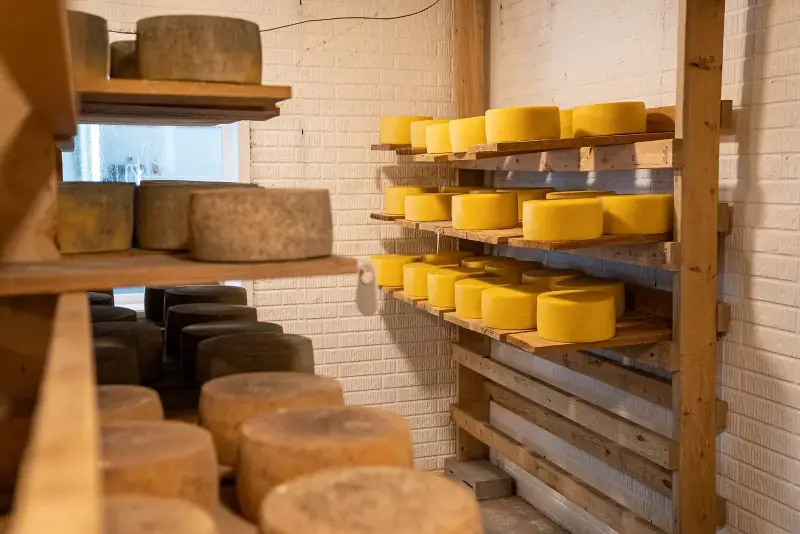
Walk into any American supermarket, pick up a block of cheddar, a wedge of parmesan, a wheel of gouda, and the enzyme that transformed liquid milk into a solid curd almost certainly began its life inside a stainless-steel fermentation tank — not inside the fourth stomach of a nursing calf. The switchover has been so complete that animal rennet is now the exception rather than the rule in American cheesemaking.
The label almost never says so. A block marked “cheddar” made with vat-grown enzyme reads the same as one made with slaughterhouse rennet. Both list “enzymes” or “rennet” in the ingredients. The molecule doing the work is identical. The organism producing it is not.
This is one of the largest, quietest ingredient substitutions in the history of American food.
What rennet actually does
Milk is mostly water with the rest split between fat, sugar, minerals and protein. The protein fraction is what makes cheese possible. Within that fraction sits casein, a family of proteins that clump together when the right enzyme cleaves a specific bond in one of them, kappa-casein. Cut that bond, and the milk separates into curds and whey. Every hard cheese on earth depends on that single cut.
The enzyme that does the cutting is chymosin. For most of dairy history, it came from one place: the abomasum, or fourth stomach, of unweaned calves. Cheesemakers would soak the stomach lining in brine, extract the enzyme, and use it to coagulate milk. A calf yielded a small amount. A wheel of Parmigiano Reggiano still requires it under Italian law. Most of the world’s cheese, once upon a time, required it too.
The shortage that forced the switch
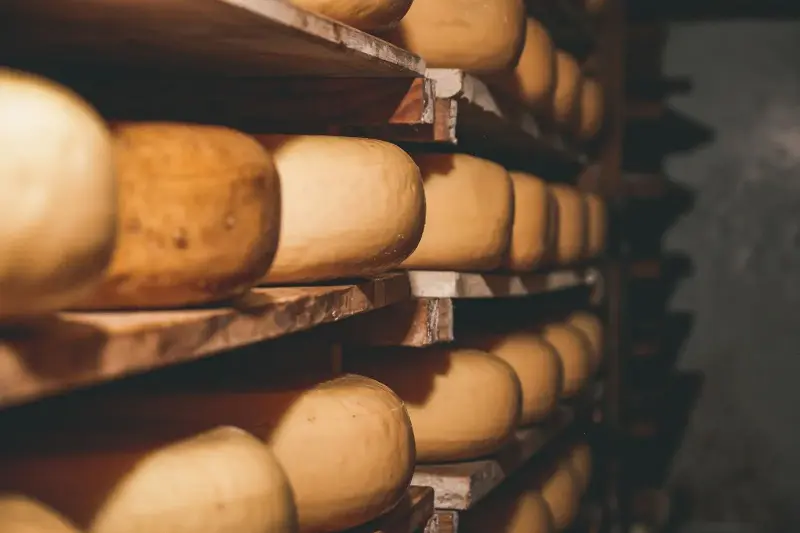
By the 1980s, global cheese consumption was climbing faster than the supply of calf stomachs could keep up with. Veal production was falling in many countries. Cheesemakers were paying rising prices for an ingredient whose supply was linked, inconveniently, to a completely different meat market. Something had to give.
In 1990, the U.S. Food and Drug Administration approved the first genetically engineered chymosin — chymosin produced by microorganisms that had been given the cow gene for the enzyme. It was one of the earliest genetically engineered products approved for the American food supply, and it entered the industry with almost no public fanfare. Cheesemakers switched because the new enzyme was cheaper, more consistent, kosher, halal, and vegetarian-friendly. Consumers, for the most part, never noticed.
Fermentation-produced chymosin now dominates industrial cheesemaking across North America and much of Europe. As trade publication FoodNavigator has reported, animal rennet now survives mainly in a small number of protected traditional European cheeses — many carrying geographical-origin designations — and among producers who prize it for its effect on flavor and texture.
How you grow an enzyme in a tank
The process is called precision fermentation, and the outline is straightforward even if the biology is not. Scientists identify the gene in the cow’s DNA that codes for chymosin. They insert that gene into a host microbe. The modified microbe now carries instructions for making a cow enzyme. Feed it sugar in a bioreactor, and it churns out chymosin as a byproduct of its own growth.
The enzyme is then filtered, purified and standardized. What ends up in the cheesemaker’s vat is chemically indistinguishable from the chymosin a calf would produce. No microbial cells make it into the final cheese. The FDA classifies it as “generally recognized as safe.”
The scale is industrial. A single fermentation run can produce enough enzyme to set thousands of vats of milk — output no farm could match. The economics were the point. The animal-welfare implications and the sustainability argument were, at the time of the switch in the early 1990s, mostly afterthoughts.
Why the label never told you
American food labeling law does not require producers to distinguish between animal rennet and fermentation-produced chymosin. Both can be listed as “rennet,” “enzymes,” or “microbial enzymes.” A block of cheddar labeled “contains rennet” tells you almost nothing about where the rennet came from.
For vegetarians, this created a minor labeling gray zone. For most consumers, it produced no visible change at all. As Modern Farmer has reported, most cheeses in US commercial markets are now made using rennet alternatives rather than calf rennet. That shift happened decades before the current wave of alternative-protein debate, and it happened without the marketing campaigns, protests or shelf-tag disclosures that have accompanied newer fermentation products.
The result is a strange asymmetry. Consumers who would balk at “lab-grown” anything have been eating a lab-grown enzyme in almost every pizza, grilled cheese and lasagna for more than thirty years. The switch was invisible because the product was identical.
The cheeses that still use the calf
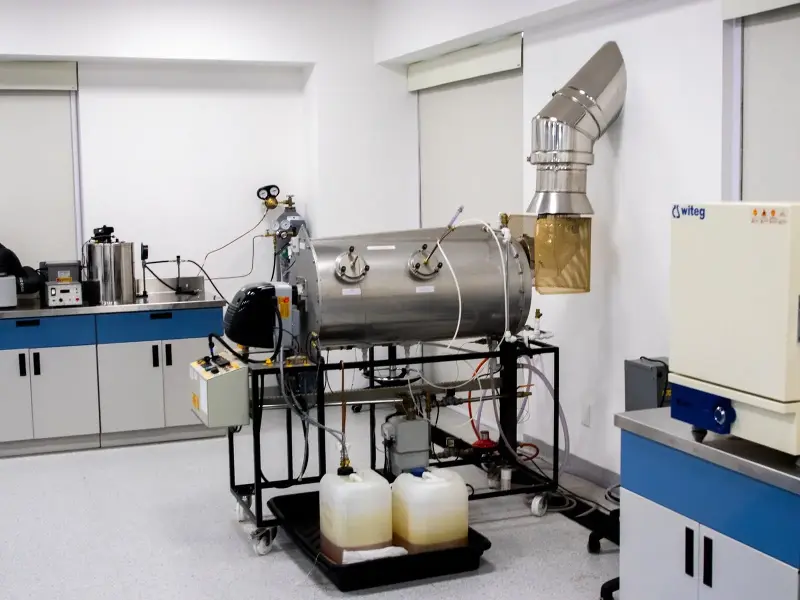
A few cheeses hold out. Some traditional European protected designation-of-origin cheeses and a subset of American artisan cheesemakers continue to use animal rennet, with some arguing it produces subtle flavor differences in long-aged cheeses.
Beyond that narrow band, the calf stomach has been retired. The industry moved on. Even many cheeses that appear traditional on the shelf — mass-market parmesan grated into a green can, supermarket gouda, block mozzarella — are almost certainly set with fermentation-produced chymosin. Most producers do not specify the enzyme source on their labeling, because they know most buyers do not ask.
What made chymosin the perfect first target
Chymosin was, in retrospect, the ideal proof of concept for precision fermentation. It is used in tiny quantities. It is highly specific in what it does. It is expensive to source from animals. And the finished product — cheese — contains none of the microbial host, only the purified enzyme it produced. That combination made regulatory approval easier and consumer acceptance almost automatic.
The same playbook is now being run on larger, more visible dairy proteins. Companies are using engineered yeast and fungi to produce whey and casein — the two major protein families in milk — with the goal of making cheese, yogurt and infant formula without a cow anywhere in the supply chain. A recent commercialization announcement from Dyadic Applied BioSolutions and Inzymes ApS described a 2026 rollout of a non-animal dairy enzyme built on the same fermentation logic that produced chymosin three decades ago.
Precision fermentation is, in fact, already embedded across the ingredient supply chain — in enzymes, vitamins, flavorings and sweeteners — long before the current wave of animal-free milk products reaches critical mass. Chymosin was the first. It has not been the last.
The 270 million cows behind a molecule
To produce the world’s dairy protein through animals, roughly 270 million cows are kept in continuous production — a herd representing a substantial global livestock population. Each animal is a working system of bones, organs and hormones, evolved over millions of years for a task that a single-celled organism in a bioreactor can now perform in a fraction of the space with a fraction of the inputs.
Chymosin was the first molecule to make that comparison uncomfortable at scale. It showed the industry could replace an animal-derived input with a microbially produced version, undetectably, cheaply, and at the volumes required to feed a national cheese habit. Whether the same substitution will hold for the protein in milk itself is the open question of the next decade.
Fermentation as the older technology
What is easy to miss in the framing of precision fermentation as futuristic is that fermentation is one of the oldest human food technologies. Yogurt, bread, beer, soy sauce, kimchi, sauerkraut and cheese itself all depend on microbes doing chemistry that humans could not do otherwise. Reviews of traditional fermented foods, including a recent Frontiers in Industrial Microbiology analysis of Portuguese traditional cheeses, describe communities that have used specific microbial cultures for generations without ever isolating a single gene.
Precision fermentation adds one step: instead of letting a microbe do whatever it naturally does, scientists give it a specific instruction — a gene — and ask it to produce one particular molecule. In the case of chymosin, that molecule is a cow enzyme. The technique is new. The underlying idea, of outsourcing chemistry to microbes, is not.
Space Daily has covered other quiet substitutions in the human food and biology story — from cultural shifts that unfold before anyone names them to the long-running work of understanding how microbial communities shape human nutrition. The chymosin story fits the pattern. A change happened. It was engineered. It was safe. It was scaled. And then it was forgotten, because the product on the shelf looked exactly the same as before.
What the enzyme change tells you about the next one
The advocates of animal-free milk protein — the companies now producing whey and casein by fermentation — often invoke chymosin as their precedent. It is the argument that when a fermentation-produced ingredient is chemically identical to its animal-derived version, the market absorbs it, the regulator approves it, and the consumer eats it without complaint.
Whether that logic scales from an enzyme used in trace amounts to a protein that makes up several percent of a finished product is genuinely uncertain. Chymosin required kilograms per year of global production. Casein and whey would require millions of tonnes. The consumer politics around dairy labeling are already more contested than they were in 1990, when the FDA approved the first recombinant chymosin with minimal public debate.
The dairy industry knows this. It also knows that the switch has, in one important sense, already happened. The enzyme that turns milk into cheese in almost every American factory today is a product of biotechnology, grown in a tank, purified, and shipped in barrels to creameries whose branding still features rolling green pastures.
Next time you slice off a piece of cheddar, consider that the last biological step in its creation — the moment liquid milk became solid curd — was performed by a molecule that a microbe made, following instructions copied from a cow. The cow was involved. The calf, for once, was not.
The post Roughly 90% of hard cheese made in the United States is now set with an enzyme grown in a vat, not pulled from a calf’s stomach appeared first on Space Daily.