



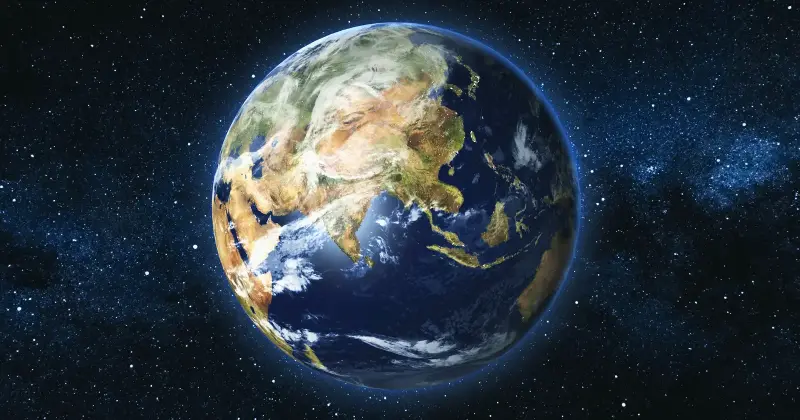
The most useful thing about compressing Earth’s history into a calendar year is not that the timestamps are perfect. They are not. The value is that the scale finally becomes visible. A planet that has existed for about 4.5 billion years can be placed inside a single familiar object: January, February, March, all the way to the final seconds before midnight on December 31.
In that calendar, almost everything recognisably human happens late. Very late. NASA’s Earth facts page describes Earth forming when the solar system settled into its current layout about 4.5 billion years ago. On a one-year scale, that makes each day about 12.3 million years long, each hour about 514,000 years, each minute about 8,600 years, and each second about 143 years.
That conversion is why the familiar line works: humans arrive near the end of the last evening, agriculture appears around the last minute, and written history is packed into the final flicker before midnight. The exact clock times shift depending on the dates used, but the shape of the picture does not. Almost all of Earth’s calendar passes without us.
The 11:36 pm human problem
The phrase “humans appear at 11:36 pm” usually depends on using a roughly 200,000-year age for modern humans. On a 4.5-billion-year Earth calendar, 200,000 years is about 23 minutes before midnight, which lands almost exactly at 11:36 pm on December 31.
But current public summaries often use an older origin for our species. The Smithsonian Human Origins Program says Homo sapiens lived from about 300,000 years ago to the present and evolved in Africa during a time of dramatic climate change. If that date is used instead, our species appears about 35 minutes before midnight, closer to 11:25 pm.
That difference is not a trivial footnote, but it also does not ruin the analogy. Whether the clock reads 11:25 or 11:36, Homo sapiens still enters after almost the entire calendar year has already passed. The Hadean, Archean, Proterozoic and nearly all of the Phanerozoic are over. The dinosaurs are gone. The ice ages are late scenes. The planet has already spent months with oceans, life, oxygen, continents, extinctions and long evolutionary experiments we never witnessed.
The deeper point is that human history is not ancient on planetary time. It is recent. Not recent as a poetic word, but recent in the arithmetic sense: the species arrives inside the final hour of a year-long Earth.
Agriculture belongs to the last minute
Agriculture arrives later still. National Geographic’s education resource on the development of agriculture places the farming transition around 12,000 years ago, when humans began moving from nomadic hunting and gathering toward settled farming and permanent communities. On the compressed Earth calendar, 12,000 years is about 84 seconds.
So agriculture does not simply arrive on December 31. It arrives at about 11:58:36 pm. Cities, stored grain, domesticated animals, property systems, bureaucracy, social hierarchy, surplus, organized labour and the long chain of technologies that followed all begin in the final minute and a half.
That is one reason this calendar image is so good at disturbing our intuition. Farming feels ancient because it sits behind almost every institution we inherited. It is older than states, older than empires, older than writing, older than the earliest named rulers. Yet on Earth’s calendar, agriculture is not an old foundation stone. It is something that happens while the clock is already approaching midnight.
Even the Neolithic Revolution, which changed the human relationship with land, food, settlement and population, is a last-minute event. The fact that it feels enormous to us says something about our scale, not Earth’s.
Written history is smaller than the phrase suggests
Writing makes the arithmetic even tighter, and also messier. The phrase “everything written down in history occupies the final 15 seconds” is a strong version of the calendar analogy. On a strict Earth-only scale, 15 seconds represents a little over 2,000 years. That would cover much of what school history courses often emphasize, but not the earliest writing.
If we go back to the first writing systems, the window is somewhat larger. World History Encyclopedia’s article on cuneiform describes cuneiform as first developed by the Sumerians of Mesopotamia around 3600/3500 BCE and developed further at Uruk around 3200 BCE. Taking roughly 5,000 to 5,500 years as the span of written history gives about 35 to 39 seconds on the Earth-year clock.
That correction matters because the calendar should not become a vehicle for false precision. If the subject is Earth’s entire history, the earliest writing occupies more like the final half-minute than exactly the final 15 seconds. But the larger point survives the correction. Written history, the part of the human past we often treat as “history” itself, is still only the last sliver of the last minute.
Everything before that had to be reconstructed through bones, tools, sediments, isotopes, ruins, cave art, DNA, pollen, ice cores and stone. The written record feels vast because it contains names, laws, debts, songs, prayers, maps, letters and claims of kings. On the planet’s own calendar, it is barely a closing note.
The calendar is really about humility
There are many ways to tell deep time. Geological eras can be set out in charts. Fossil lineages can be drawn as branching trees. Extinction events can be plotted against atmospheric chemistry and climate. Those forms are accurate, but they often leave the mind untouched. Numbers in the billions can become too large to feel.
The calendar works because it borrows a rhythm we already understand. January feels far from December. A minute feels small. Midnight feels final. Once Earth is placed into that frame, human importance becomes hard to inflate. We are not the main body of the year. We are the late entry.
This does not make human life meaningless. It does almost the opposite. It makes human life improbable, concentrated and consequential. In the final instants of the calendar, one species began changing landscapes, moving species across oceans, altering atmospheric chemistry, splitting atoms, launching machines beyond the planets and looking back at Earth from space.
The compression is unsettling because it combines insignificance and power. We appear late, but not quietly. Agriculture remakes ecosystems. Writing preserves memory outside the body. Industrial civilization changes the air. Spaceflight gives the planet, for the first time as far as we know, an observer capable of seeing it whole.
A late species with an old planet underneath it
It is easy to say that Earth is old. It is harder to feel what that means. The compressed calendar helps because it turns the planet’s age into a lived sequence. For almost the entire year, there are no farms, no cities, no ships, no telescopes, no alphabets, no borders, no clocks, no recorded languages, no human names.
Then, in the last hour, Homo sapiens appears. In the last minute and a half, farming changes the species’ relationship with food and place. In the last half-minute, writing begins to catch human memory in clay, stone, ink and eventually code. In the last seconds, modernity accelerates so quickly that the analogy almost breaks under it.
The calendar is not exact enough to settle debates about human origins, the definition of history or the start of civilization. It is not meant to be. It is a scale model of perspective. And on that model, the lesson is plain: everything we call the human world rests on a planet that was already almost finished with its year before we arrived.
The post If you compressed the entire history of Earth into a single calendar year, humans appear at 11:36 pm on the 31st of December, agriculture at 11:59, and everything written down in history occupies the final 15 seconds before midnight appeared first on Space Daily.