



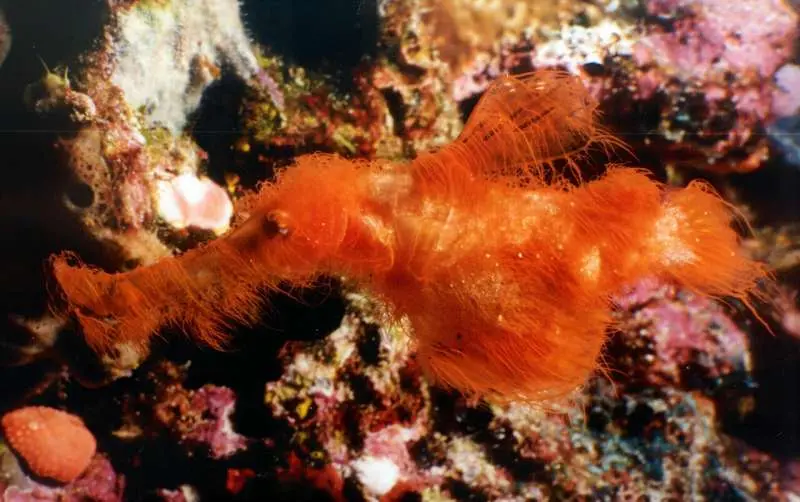
Swimming among the corals of the Great Barrier Reef is a fish that could be a doppelganger for the famous Sesame Street character Mr. Snuffleupagus. This bright orange-red, hairy, long-snouted ghost pipefish is a new species that has been hiding in plain sight for years, often confused with other ghost pipefish.
A Muppet under the sea
The reason for the confusion is that ghost pipefish are masters of camouflage that can easily melt into their backgrounds. These close relatives of seahorses and sea dragons often closely match the color of their surroundings and develop skin filaments that look like algae or coral. Because they are so well disguised, scientists have sometimes struggled to determine one species from another.
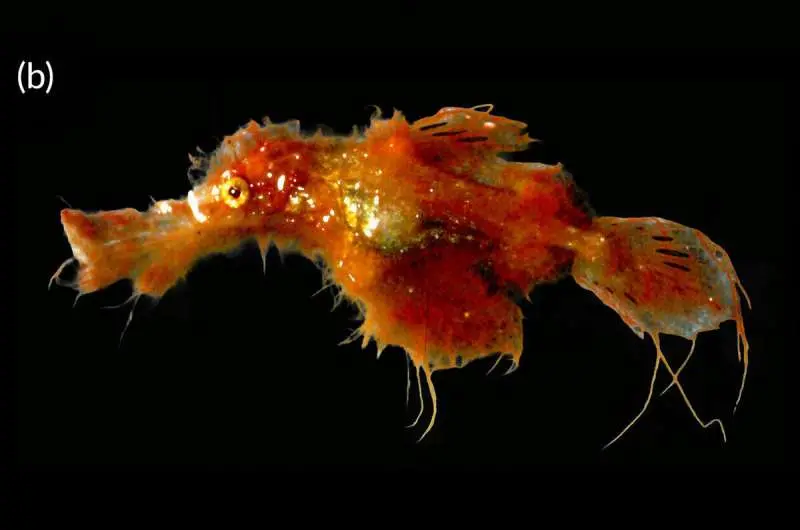
The new species, now called hairy ghost pipefish (Solenostomus snuffleupagus), had been known for years, with divers and underwater photographers uploading videos to Facebook groups and citizen science platforms like iNaturalist. Most people assumed they were looking at the known rough ghost pipefish species (Solenostomus paegnius) because both animals share a similar shaggy look.
However, marine biologist David Harasti and research partner Graham Short started to notice consistent morphological differences between the fish in photographs and museum specimens and decided to investigate.
Their discovery is published in a paper in the Journal of Fish Biology. "The conspicuous shaggy appearance conferred by abundant elongate filaments is consistently observed across the species' known range," they wrote.
Identifying a new species
To prove this was indeed a new species, the researchers analyzed mitochondrial DNA from two specimens collected from the Coral Sea and compared it with DNA records of the rough ghost pipefish. They found a 22% genetic difference between them, strong evidence that they were looking at a different species.
Harasti and Short also created 3D models of the skeleton based on high-resolution micro-CT scans. When they compared the bones of the new fish to those of the other species, they discovered a greater number of vertebrae. Unlike its relatives, which have 32–34 vertebrae, the new species has 36 vertebrae. The scans also revealed unique star-shaped bony structures embedded in the skin.
Additionally, the researchers took the old-school approach of carefully measuring the body proportions and fin shapes of museum samples. This revealed that the hairy ghost pipefish has a more compact, chunkier body than its relatives.
"The integration of high-resolution micro-CT imaging with traditional morphological and molecular approaches provides new insights into the osteological diversity of Solenostomus."
As well as this new find, the work also hints at potential future discoveries. The Great Barrier Reef, like many other parts of our oceans, has been extensively researched, but it is still turning up surprises.
Written for you by our author Paul Arnold, edited by Sadie Harley, and fact-checked and reviewed by Robert Egan—this article is the result of careful human work. We rely on readers like you to keep independent science journalism alive. If this reporting matters to you, please consider a donation (especially monthly). You'll get an ad-free account as a thank-you.
Publication details
Graham Short et al, Solenostomus snuffleupagus sp. nov., a hairy ghost pipefish (Teleostei: Solenostomidae) from the Southwest Pacific, with an integrative comparison to S. paegnius, Journal of Fish Biology (2026). DOI: 10.1111/jfb.70497
© 2026 Science X Network
Citation: Hairy new fish species discovered in the Great Barrier Reef (2026, May 14) retrieved 14 May 2026 from https://phys.org/news/2026-05-hairy-fish-species-great-barrier.html
This document is subject to copyright. Apart from any fair dealing for the purpose of private study or research, no part may be reproduced without the written permission. The content is provided for information purposes only.