



In some parts of the world, autumn brings welcome relief from mosquitoes, such as the Northern house mosquito (Culex pipiens). As the days grow shorter, the waning light is a signal for them to enter a winter state of dormancy called diapause.
However, according to new research published in the Journal of Applied Ecology, artificial light from common household fixtures, such as porch lights, may be keeping them active for longer. And that could put more of us at risk if they carry dangerous pathogens like the West Nile virus.
City lights trick the clock
Artificial light at night (ALAN) is known to disrupt the natural day-night cycles of many organisms, such as plants, birds, and some insects. But less is known about how it impacts mosquito dormancy.
In this study, researchers at Ohio State University, U.S., looked at both light pollution and the Urban Heat Island effect, in which urban areas are warmer than surrounding rural areas.
Backyard experiments
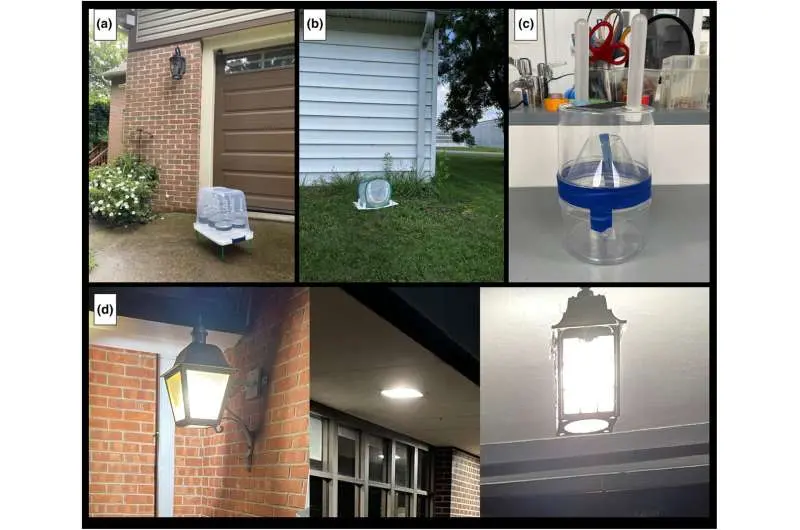
They placed mosquito enclosures in residential yards, churches, and school grounds in Columbus, Ohio. Each property hosted two cages containing mosquito larvae. One cage was left under a common outdoor light source, such as a garage light, and the other was placed in a dark spot. Meanwhile, data loggers tracked the exact temperature and light levels every thirty minutes.
Once the mosquitoes grew into adults, the research team examined and tested them in the lab. This included testing them for dormancy, reproduction (how many females laid eggs and if they hatched into larvae), and blood-feeding (their urge to bite an artificial membrane filled with chicken blood).
So what did they find?
Light was a stronger inhibitor of dormancy than warming urban temperatures. In the dark cages, all of the mosquitoes entered the dormant state in October as temperatures dropped. But in the lit cages, the presence of light appeared to override many of the seasonal cues tied to colder weather. Some mosquitoes still entered dormancy, but many behaved as though it was still summer.
In the lab tests, they were more likely to take a blood meal, had larger egg follicles, and produced eggs that hatched into larvae deep into October.
The team also discovered that low-intensity lights, which are often thought to be less disruptive to wildlife, kept mosquitoes active.
"Low intensities of warm white ALAN were a stronger inhibitor of diapause initiation than urban warming, indicating that changes in brightness or light color may not be sufficient to mitigate ecological impacts," explained the scientists in their paper.
"ALAN from common sources can extend seasonal mosquito biting activity and reproduction into late autumn. This study reveals a potential explanation for higher mosquito-borne disease risk in cities."
Written for you by our author Paul Arnold, edited by Gaby Clark, and fact-checked and reviewed by Robert Egan—this article is the result of careful human work. We rely on readers like you to keep independent science journalism alive. If this reporting matters to you, please consider a donation (especially monthly). You'll get an ad-free account as a thank-you.
Publication details
Lydia R. Fyie et al, Artificial light at night (ALAN) is a stronger inhibitor of overwintering dormancy than urban warming in mosquitoes, Journal of Applied Ecology (2026). DOI: 10.1111/1365-2664.70407
© 2026 Science X Network
Citation: Outdoor lights may keep mosquitoes biting and breeding deeper into autumn (2026, May 27) retrieved 27 May 2026 from https://phys.org/news/2026-05-outdoor-mosquitoes-deeper-autumn.html
This document is subject to copyright. Apart from any fair dealing for the purpose of private study or research, no part may be reproduced without the written permission. The content is provided for information purposes only.