



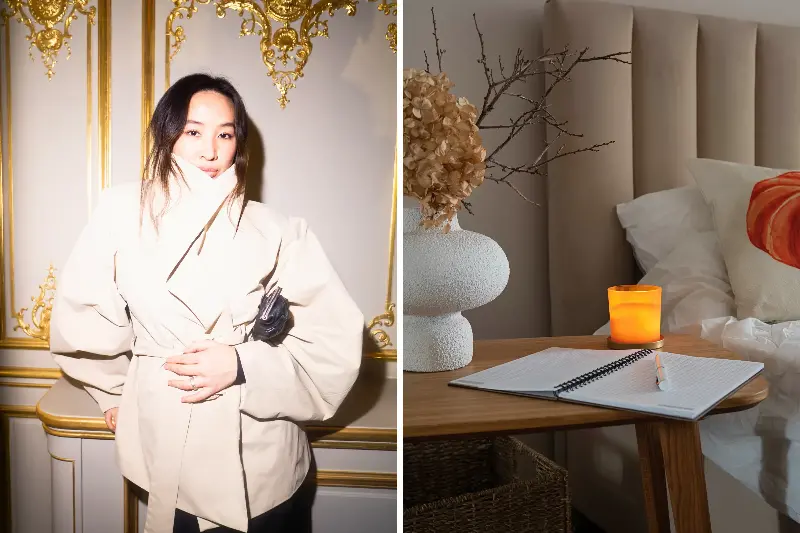
For Generation Z, bedside tables are no longer just for sleep essentials, and the few items that typically rest on them are no longer permanently there.
A new TikTok‑driven trend known as “bedtime stacking” sees mostly young women rounding up everything from journals and books to beauty products, snacks and laptops, turning their beds into all‑in‑one hubs for rest, productivity and self‑care at the end of long days at work.
What Is Bedtime Stacking?
The trend has surged across TikTok in recent weeks, with micro-creators sharing carefully curated stacks designed to let them do as much as possible from one spot. One of the most widely viewed videos came from Sweden‑based Linnéa Pham, whose walk through of her own bedtime stack on January 23 garnered more than 37,000 likes.
“A bedtime stack is when you go to bed early, you decide to just do as much as you can at the same spot without leaving,” she told viewers.
Pham proceeded to walk viewers through her stack in calm, muted tones. There is hand cream and a neck massager for winding down, a clear glass dish of chips for what she calls “bed snacking,” a Filofax and a book. An iPad sits open with a digital magazine and a puzzle game ready to go, alongside a television remote, water and other small comforts.
The effect is both cozy and deliberate—a neatly contained ecosystem of hobbies and habits designed for one long stretch of intentional downtime. But, for Pham, sharing her “bedtime stack” did not come without hesitation.
“I worried about what people might think of me for doing everything in bed, that they might see me as a slob,” she told Newsweek. “I’ve never really seen anyone do it before, aside from that one scene in The Parent Trap when Elizabeth (Natasha Richardson) is lying in bed working.
“So I would say the idea felt original to me—but, since the video went viral and so many people responded saying they do this too, they just didn’t have a name for it. I guess we can all agree that, in the age of social media, none of us really has a completely original thought. I simply gave it a name.”
The New Habit Stacking
Bedtime stacks typically include a mix of items: journals, laptops, beauty products, water bottles, books, snacks and tech, all clustered around the bed so that ‘stackers’ can move between hobbies and activities without getting up. Pham frames bedtime stacking as a more-mindful alternative to another Gen Z‑coined habit.
“It’s basically ‘bed rotting’s’ older sister,” she said. “But, instead of doomscrolling, I use the time to consume other types of media.
“While doomscrolling can sometimes make you feel guilty, like you’re wasting time, bed stacking feels intentional. You may not be physically active, but you’re mentally engaged.”
That sense of intention helps explain why the trend has resonated so quickly, particularly among young women.
Bedtime stacking borrows from the productivity concept of habit stacking, which encourages people to layer small, positive behaviors together to make routines easier to maintain. Rather than separating reading, journaling, skincare, entertainment and planning into different moments—or abandoning them altogether at the end of a long day—bedtime stacking compresses them into one contained ritual.
The trend also reflects where culture has shifted for Gen Z.
It leans into maximalism and the resurgence of the “messy cool girl” trend, rejecting minimalist nightstands in favor of scattered books, notepads and nicknacks. At the same time, it speaks to the pressure many young people feel to keep up with everything at once, even while trying to rest.
“This trend speaks strongly to Gen Z’s experience of FOMO [fear of missing out] and a broader anxiety about time scarcity,” Dr. Jordan Ashley, a sociologist and founder of Souljourn Yoga Foundation, told Newsweek. “Many young adults feel pressure to do everything at once: stay informed, be productive, maintain hobbies, practice self‑care, and remain socially connected.”
Ashley pointed to the way bedtime stacking blurs long‑standing boundaries.
“What’s particularly notable is the erosion of boundaries between work, rest, and social life,” she said. “The bed, historically a space reserved for sleep, becomes a multifunctional hub. When laptops, planners, skincare routines, and social media coexist in the same physical space, it reflects a difficulty in compartmentalizing different roles of the self. There is less separation between ‘on’ and ‘off’ time.”
That blurring, Ashley added, can heighten anxiety in a culture shaped by constant visibility and performance.
“Even rest can become content,” Ashley said. “The pressure to be constantly engaging, optimizing, or curating one’s life feeds into the sense that one must always be ‘on’, even while winding down.”
Still, she said the bed’s symbolic pull should not be overlooked.
“The bed represents safety and containment,” Ashley said. “By bringing everything into that space, individuals may be attempting to create a controlled environment where they can manage multiple demands without fully stepping back into the external world. It becomes both a sanctuary and a stage.”
But, for Pham, bedtime stacking is not about optimization.
“It’s for those of us who are tired after a full day of work and just need some intentional downtime to enjoy the things we like, all from one cozy spot,” she said.