



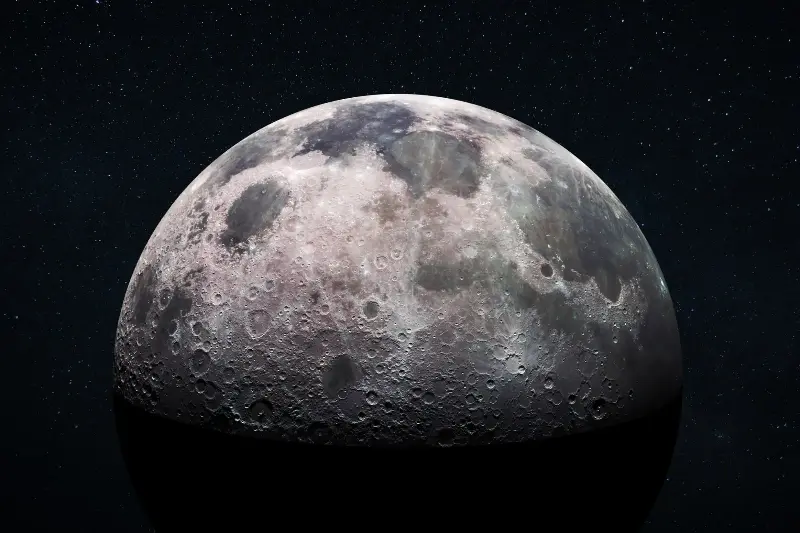
Living on the moon has long been the stuff of science fiction, but NASA says it is working toward making it a reality.
Through its Moon Base Program, the agency has outlined a phased plan to establish an enduring human presence near the lunar South Pole.
In May, NASA unveiled a detailed plan for building a Moon Base near the lunar South Pole. The third and final phase of the plan seeks to achieve “sustained human presence,” which NASA described as the point when “living and working on the Moon becomes a reality.”
While futuristic visions may often focus on gleaming cities, experts say everyday life on the moon is likely to be far more practical and more challenging.
Living Primarily Indoors
George Sowers is a professor for the space resources program at the Colorado School of Mines and has previously served on the Human Exploration and Operations (HEO) Committee of the NASA Advisory Council.
“The most challenging thing for humans on the moon is that the moon has no atmosphere. It has no magnetic field, so it’s directly exposed to space radiation,” Sowers told Newsweek.
Extreme temperatures present another obstacle. NASA says temperatures near the lunar South Pole range from more than 130 degrees Fahrenheit in sunlit regions to as low as minus 334 degrees Fahrenheit inside permanently shadowed craters.
Because of those conditions, Sowers expects most people to spend their lives indoors beneath protective layers of lunar soil.
“You’ll be living primarily indoors, underneath amounts of dirt, to protect you, and your excursions to the outside will be very limited and controlled,” he said.
Sowers noted that astronauts must manage their radiation exposure throughout their careers because every trip outside contributes to lifetime radiation limits. As a result, he anticipates “heavy use of robotics” to perform many outdoor tasks.
If sufficiently shielded habitats can be built, however, Sowers believes people could potentially remain on the moon indefinitely, provided they carefully manage outside exposure.
Even tourism could eventually become possible. Short visits, he suggested, would not pose the same radiation concerns as long-term residence.
Unlimited Access to Solar Energy
While water may underpin the lunar economy, Sowers believes the most transformative long-term benefit of living and working on the moon could be energy production.
“The biggest tangible benefit is space solar power, which would basically provide inexhaustible, abundant energy for everybody on Earth forever,” he said.
According to Sowers, one of the most promising uses of lunar resources would be constructing massive structures in space using materials mined from the moon. Among those structures could be large solar power satellites capable of generating energy far more efficiently than solar panels on Earth.
He explained that conventional solar power faces several limitations because it only generates electricity when the sun is shining and becomes less effective during winter months. Moving solar collectors into space would eliminate many of those challenges.
Sowers said solar power satellites could collect energy at greater intensity because there is no atmosphere to weaken incoming sunlight. Unlike terrestrial solar power, which is intermittent and typically requires backup systems, orbital solar power could provide energy continuously.
“But if you have solar power satellites in space, that could provide completely green energy, inexhaustible, available 24 hours a day, 365 days a year,” Sowers said. He added that building such satellites from lunar materials could be far cheaper than manufacturing them on Earth and launching them into orbit.
Looking further ahead, Sowers said he believes using lunar resources to construct solar power satellites is realistically achievable within the next 50 years. “That could completely change the energy situation on Earth and essentially make fossil fuels obsolete,” he said.
From Research Outpost to Industrial Hub
Deana Weibel, an anthropology professor at Grand Valley State University and author of The Ultraview Effect: What We Can Learn from Astronauts about Awe, Humility, and Exploring the Unknown, said lunar life will likely resemble life at an isolated research station more than a futuristic space colony.
Weibel told Newsweek: “One thing that may come as a surprise is that everyday life on the moon will probably feel less like science fiction and more like living in an extremely remote research station, similar to McMurdo Station in Antarctica.”
“Much of each day will likely focus on maintenance, safety procedures, cleaning, and protecting equipment from the very abrasive lunar dust,” Weibel said. What initially feels like an “extraordinary environment,” she added, would soon become a normal workplace.
Sowers similarly expects the first moon base to operate as a permanent scientific installation before evolving into something much larger. Over time, he believes the moon could become an industrial hub supporting manufacturing in space, using lunar materials to construct large structures such as solar power satellites.
Despite the ambitious timeline, Sowers expects challenges ahead. He praised NASA’s goal of achieving sustained human presence on the moon by 2032 but said delays are likely as engineers work through inevitable “glitches and road bumps.”
Do you have a tip on a science story that Newsweek should be covering? Do you have a question about space exploration? Let us know via [email protected].