


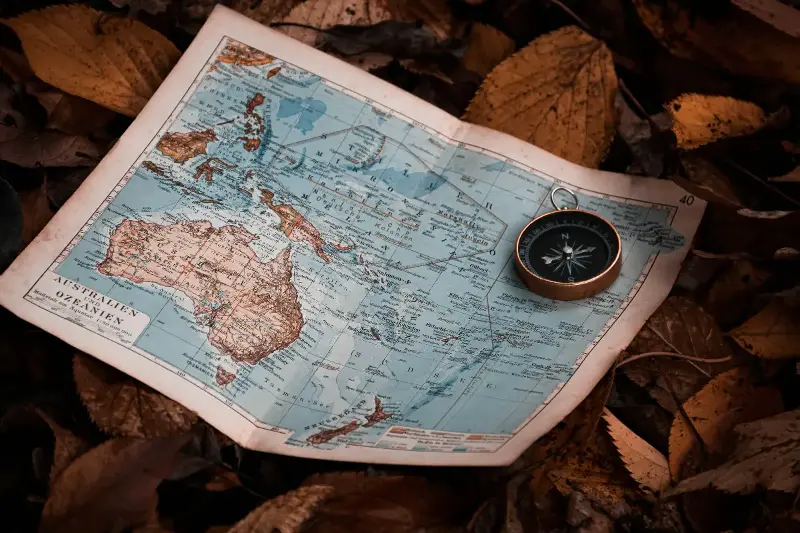
Long before maps were a mere tap away on a smartphone screen, the world was a vast, uncharted puzzle. Ancient travelers, merchants, and rulers depended entirely on hand-crafted maps to make sense of geography, plan arduous journeys, and expand their reach.
The early development of cartography, or mapmaking, is not just a story of scientific advancement. It is a brilliant human tale colored by bold imagination, cultural pride, fine art, and ancient folklore. Every single line scratched onto parchment or etched into a clay tablet represented raw discovery, mystery, and a deep desire to comprehend the unknown.
DAWN OF MAPS: CHARTING THE FIRST BOUNDARIES
The earliest maps were likely drawn in shifting sands or carved into rugged rock faces, lost to history but echoed by later artifacts. As civilizations grew, they looked for permanent ways to record their surroundings.
- The Babylonian World Map: Dating back to the 6th century BCE, this clay tablet (Imago Mundi) is one of the oldest surviving examples. It features a simple, circular design focusing on Babylon at the center, surrounded by mysterious regions represented as triangles.
- The Turin Papyrus Map: Created around 1150 BCE in ancient Egypt, this map illustrates the location of valuable stone quarries in the desert. It proves that maps were vital tools for economic planning and resource tracking thousands of years ago.
CLASSICAL WORLDS: SYSTEMATIC AND MEASURED PERSPECTIVES
The ancient Greeks completely revolutionized mapmaking by introducing the groundbreaking idea that geography could be systematic, mathematical, and physically measured.
- Anaximander (6th Century BCE): Drew what is thought to be the first world map, boldly hypothesizing about land masses beyond the known edges of his world.
- Eratosthenes: Calculated the Earth’s actual circumference with surprising accuracy using simple geometry and the angles of shadows.
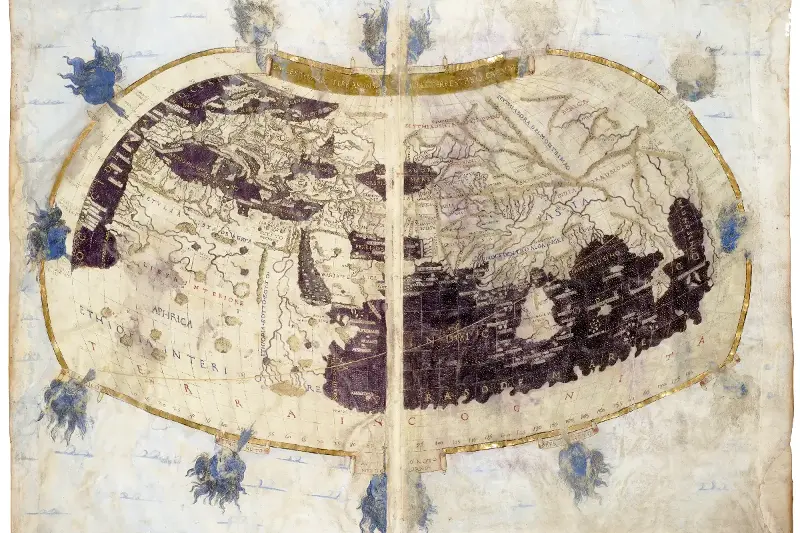
- Claudius Ptolemy (2nd Century CE): Compiled his seminal work, Geographia, in Alexandria. His maps utilized early concepts of latitude and longitude, demonstrating a massive leap forward in accuracy.
Because these documents were painstakingly copied and redrawn by hand for centuries, unique artistic liberties inevitably crept into the designs, blending objective science with personal and cultural viewpoints.
MEDIEVAL MAPPING: PIETY AND PRECISE STRIDES
As the centuries turned, maps grew richer, more elaborate, and occasionally highly symbolic. European and Islamic scholars took vastly different, fascinating approaches to charting the globe.
In medieval Europe, the famous Mappa Mundi—such as the Hereford Map from around 1300—mixed basic classical geography with biblical history. These grand tapestries were filled with intricate illustrations of exotic animals, distant cities, and mythical creatures, often placing sacred sites at the literal center of the world to reinforce a religious worldview.
Simultaneously, the Islamic world was making immense scientific strides. In the 12th century, the geographer Al-Idrisi constructed a remarkable silver disk map for King Roger II of Sicily. This masterpiece perfectly combined geographical knowledge from across the Muslim and Christian worlds, creating an advanced, highly accurate bridge between different civilizations.
AGE OF DISCOVERY: THE GOLDEN ERA OF EXPLORATION
The 15th and 16th centuries sparked a golden age of exploration, turning maps into the most critical, high-stakes tools for sailors crossing treacherous, unknown seas.
- Portolan Charts: Developed by skilled Mediterranean navigators, these charts showcased remarkably precise coastlines, natural harbors, and wind directions, all cross-hatched with vibrant, elaborate compass roses.
- The Waldseemüller Map (1507): This hand-drawn masterpiece was the very first global map to label the "New World" as America. Based on the frantic reports of early explorers, it forever altered humanity's understanding of global geography.
SECRET CODES AND MASTERFUL ARTISTIC FLOURISHES
Hand-drawn maps were far more than practical navigation aids; they were prized expressions of exquisite artistry and carefully guarded secrets. Political leaders routinely commissioned ornate maps to impress rivals, filling blank ocean spaces with illustrations of majestic ships, mythical sea monsters, and intricate golden borders.
Many maps even contained clever, intentional distortions or hidden trails designed to protect valuable trade routes from competitors. Artists collaborated closely with cartographers, transforming legal land deeds into dazzling works of art adorned with decorative banners, family crests, and beautiful border illustrations that infused vital functionality with immense personal pride.
MAPS AS UNIQUE CULTURAL MIRRORS
Every ancient map acts as a mirror, revealing exactly how a society viewed its place in the universe. Chinese cartographers in the 12th century naturally placed their empire at the absolute heart of their world maps, while Aztec codices used vivid pictograms to depict sacred landscapes and historical journeys.
The beautiful evolution from ancient worldviews to modern precision laid the vital groundwork for the technology we use today. While modern navigation is undeniably efficient, ancient hand-drawn maps still capture our imagination, reminding us that exploring the world has always been driven by human curiosity and creativity.